
By Michael Phillips
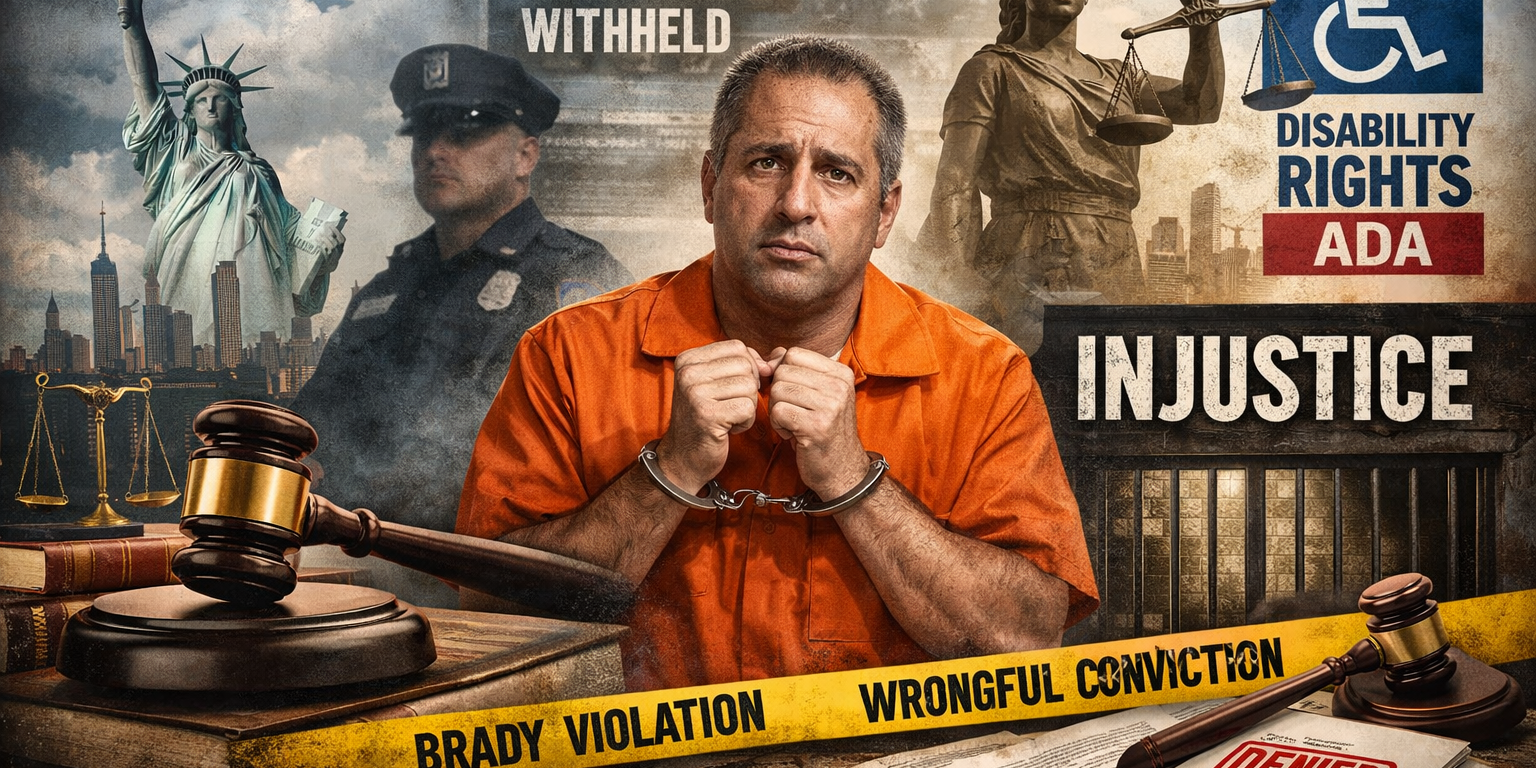
New York likes to present itself as a national leader on civil rights, disability access, and criminal justice reform. But the ongoing prosecution and sentencing of Marc Fishman tells a very different story—one that exposes how easily disabled defendants can be crushed when prosecutors ignore exonerating evidence and courts fail to enforce the law.
Marc Fishman is not asking for special treatment. He is asking for the law to be followed.
A Case That Should Have Ended Years Ago
Marc’s ordeal began on December 15, 2018, during a court-ordered, prepaid, supervised visitation with his child. A supervisor was present. A disability aide was present. Marc had a valid visitation order in hand.
Despite all of this, he was arrested by New Rochelle police officer Lane Schlesinger—an officer who would later admit on withheld police video that Marc had no intent to commit a crime.
That video, along with police radio calls and internal records proving Marc’s innocence, was never disclosed to the defense. Marc only obtained it years later by suing the police in federal court.
That alone should have ended the prosecution.
It didn’t.
The Arresting Officer Was Later Branded a Pattern Abuser
In May 2024, New York Attorney General Letitia James officially designated Officer Schlesinger as “pattern misconduct”—the only officer in Westchester County to receive that designation in the last five years. He was later fired.
The State of New York has formally acknowledged that the central witness against Marc Fishman was a repeat abuser who falsified reports and abused his authority.
Yet Marc’s conviction still stands.
The Westchester County District Attorney’s Office, now led by Susan Cacace, has refused to correct the record, address the Brady violations, or acknowledge that its case rests on the word of a disgraced officer.
ADA Rights Ignored at Every Stage
Marc is severely disabled. He lives with traumatic brain injury, neurological pain, and cognitive impairments that directly affect communication and processing.
In 2021, the United States Court of Appeals for the Second Circuit ordered Westchester courts to provide him with ADA communication accommodations.
Those accommodations were still denied when they mattered most.
When Marc sought an emergency stay to prevent a 45-day jail sentence, he could not use the court’s electronic filing system because of his disability. His attorney was in trial. Marc pleaded—repeatedly—for assistance.
The system responded with silence and procedural indifference.
This is not an edge case. This is what systemic ADA failure looks like in real life.
Prosecutorial Ethics Were Not Optional
Prosecutors are not allowed to ignore innocence.
New York’s ethical rules require prosecutors to disclose exonerating evidence, correct false testimony, and act when credible evidence shows a conviction is unsafe. Proceeding anyway is not “zealous advocacy.” It is misconduct.
When a conviction depends on:
- Withheld exculpatory evidence
- A corrupt officer later fired for misconduct
- A defendant denied ADA-mandated access
…the ethical obligation is clear.
Drop the case.
Why This Case Affects Everyone
Marc Fishman’s fight is not just about one man. It is about whether disabled defendants have any meaningful protection when courts and prosecutors choose convenience over justice.
If a disabled father can be jailed despite sworn video evidence of innocence and official findings of police corruption, then no ADA right is secure—and no reform slogan means anything.
New York created oversight bodies like the Commission on Prosecutorial Conduct for cases exactly like this. The question now is whether those institutions will act—or simply exist on paper.
A Call for Accountability
Marc Fishman should not be in jail.
Not for a crime he did not commit.
Not on the testimony of a corrupt officer.
Not while exonerating evidence sits ignored.
This case demands immediate action, not quiet delay.
Justice delayed here is justice denied—for Marc, and for every disabled New Yorker who expects the law to protect them rather than punish them.
Supporting documentation and correspondence referenced in this post are drawn from court filings, official findings, and contemporaneous records.
 New Rochelle Police Abuse